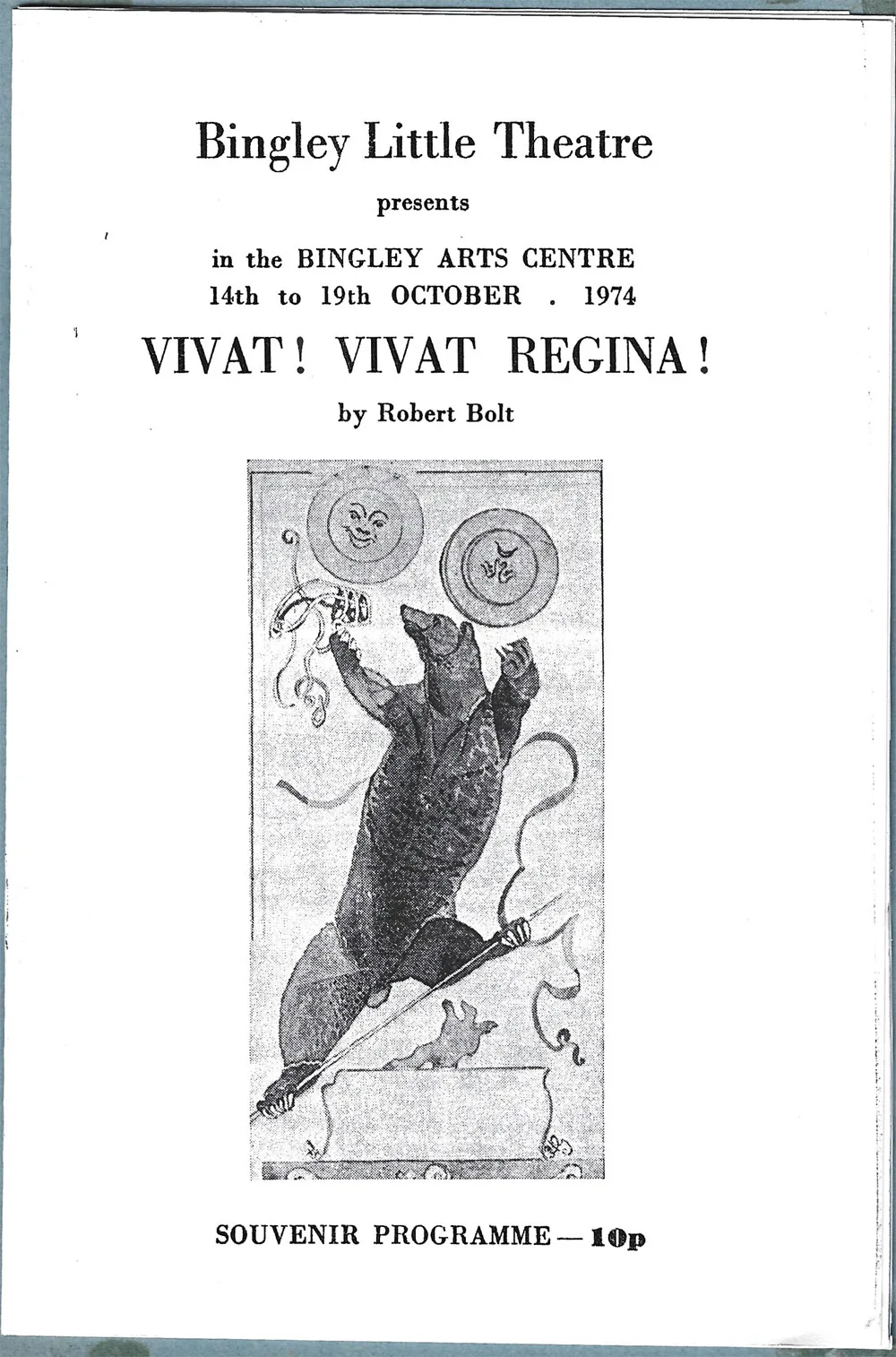

Season 27 Play 1 – Vivat! Vivat Regina! by Robert Bolt
Directed by
Cast
CLAUD NAU – ROBERT GREEN
WILLIAM CECIL – FRANK RUSHWORTH
ELIZABETH – OLGA NUTTER
ROBERT DUDLEY – JOHN BURGESS
KNOX – ROLAND COOMBES
RIZZIO – ROB BELL
MORTON – JOHN GOLDSBOROUGH
BOTHWELL – DAVID WEST
BISHOP OF DURHAM – CLIFFORD FOSTER
A CLERIC – ROBERT SHAW
WALSINGHAM – C. E. PETER WALKER
DE QUADRA – HARRY CHAPMAN
DAVISON – NICHOLAS GIBBON
DARNLEY – GORDON LAKIN
LORD MOR – ROBERT JONES
RUTHVEN – ROBIN DEARDEN
DOCTOR – ALLAN STEWART
TALA – DONALD CLOUGH
ORMISTON – GORDON SUGDEN
A PRISONER – PETER HEATON
CARDINAL – PETER HEATON
JAILERS – ROBERT SHAW, DONALD CLOUGH
BREWER – PETER KELLY
SCOTS ARCHBiSHOP – JESSE SCARFE
DAUPHIN – JONATHAN SCOTT
QUEEN OF FRANCE – BARBARA CHAFFER
SCOTTISH COURT LADIES – SUZANNE LAKIN, ELIZABETH CHAFFER
ENGLISH COURT LADIES – BARBARA CHAFFER, CHRISTINE SWINDLEHURST, HILARY BRICE
COURTIERS – ALLAN STEWART, DONALD CLOUGH
STAGE HANDS – MARTIN WOOFF, CHRISTOPHER ROSSINGTON, ANN BRUMFITT, PAMELA ASHWELL
CHORISTERS – ANDREW BAILEY, CHARLES WHITWHAM
Synopsis
..
Directors Notes
“Long live the Queen!” which Queen? Does Bolt mean Queen Elizabeth | or Mary Queen of Scots? Or merely “THE QUEEN” as a symbol, signifying the THRONE?
Which is important-_-the person, or what the person stands for?
In this gripping, tempestuous play, full of pageantry and colour, of good and evil, we have the story of the conflict between the two Queens: Elizabeth, implacable but personally unfulfilled, ready to subjugate all personal dreams in order to make her throne secure: and Mary, tossed every which way by her passionate determination to achieve her personal dreams, to “live her life fully” at whatever cost.
Look closer, however, and what do we find? Behind both Queens there stand darker figures. Behind Elizabeth we see Cecil, the old fox, and Walsingham, the pragmatist, both ready to manipulate anybody and anything to keep England ‘safe. And Dudley, representing as he does, all Elizabeth’s ‘might have been’
Behind Mary, her uncle, the Cardinal, educating her to be a Queen first, second and all the time: and Bothwell, what of him? Margaret Irwin calls him ‘The Gay Galliard’, but this is not the image we have from Bolt. His is the power that pushes Mary to the precipice edge, and then deserts her, to save his own skin. And Morton, who will gladly sacrifice anybody, so long as he survives.
Who are the puppets and whose hands are on the strings? Are the Queens so powerful, or are they pawns masquerading as queens?
In all this turmoil and excitement, one thing is constant_-the Throne itself, and it is in their attitudes to the Throne that the two women show their differences most clearly. Why does Elizabeth want to keep the Throne? For herself, for her own glory? Of course, but look how she schemes to get control of Mary’s little son-and why does she want him? To ensure the succession. That is the centre of Elizabeth’s entire life, a ‘safe’ succession, a ‘safe England.
But to Mary the Throne is both more than that, and less than that. For her it is present power, present state, a personal tribute. It is the justification of her dreams, and more than that, it is her ‘right and due’.
For the Throne, Elizabeth subdues all her private hopes and dreams, for her private hopes and dreams, Mary sacrifices the Throne.
But- -and this is a very big BUT–this play is not a history lesson. It is the author’s view of, a turbulent, romantic tale of ambition and rivalry, of love and death. It is a game in which nobody wins. Listen to Elizabeth’s last words and learn how frail a thing is temporal power. In Marlowe’s immortal lines:</p>
“But what are Kings when Regiment is gone,
But perfect shadows in a sunshine day?”